Atmospheric chemistry
Marine sulfur cycle
Separating biological change from pollution-driven shifts in atmospheric oxidation and methanesulfonic acid (MSA).
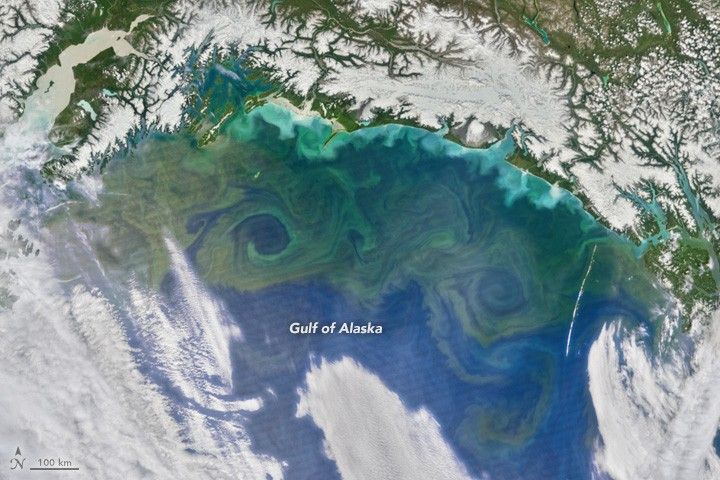
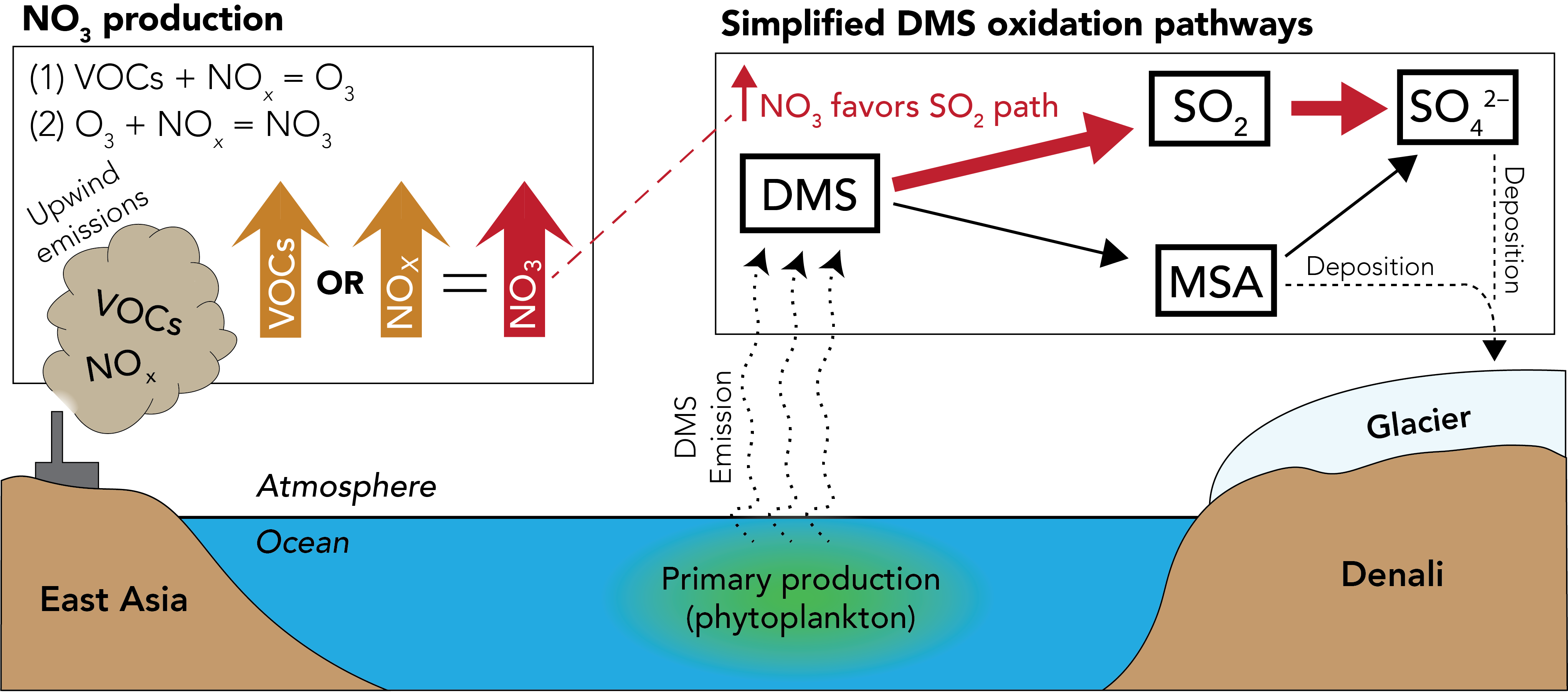
Marine phytoplankton release dimethyl sulfide (DMS), a gas that helps form atmospheric aerosols and influences cloud formation over the oceans. One of its oxidation products, methanesulfonic acid (MSA), is preserved in polar ice cores and has long been used as a proxy for past marine productivity. However, many Arctic ice-core records show a sharp decline in MSA beginning during the Industrial Era—a trend that was widely interpreted as evidence of crashing phytoplankton populations.
Using ice cores from Denali and Greenland together with atmospheric chemistry modeling, we found a different explanation. Rather than reflecting widespread changes in ocean biology, the decline in MSA is primarily the result of anthropogenic air pollution altering the chemistry of the atmosphere. As illustrated in Figure 1, pollution changes the oxidation pathways of DMS, causing less MSA to form before the air masses reach the Arctic. This work demonstrates that industrial emissions have fundamentally altered atmospheric chemistry even in Earth's most remote regions, while also redefining how scientists interpret one of the Arctic's most important ice-core proxies for the marine environment.
Related publications
Pollution drives multidecadal decline in subarctic methanesulfonic acid
Nature Geoscience 17, 1016–1021
Dimethyl sulfide chemistry over the industrial era: comparison of key oxidation mechanisms and long-term observations
Atmospheric Chemistry and Physics 25, 4083–4106